
Transportation & Logistics Analytics Beyond Fleet Management: A CTO’s Roadmap for Strategic Impact
Traditional transportation analytics has mostly focused on fleet management, including energy savings, maintenance scheduling, and route optimization. While these are significant, they are merely just the beginning of the possibilities that analytics may reveal. As mobility in cities, international supply chains, and passenger expectations change, CTOs must go beyond the dashboard and consider wider strategic issues. The challenge is no longer about only fleet performance; it’s also about setting up an intelligent, integrated data infrastructure that allows for more informed decisions across the whole transportation ecosystem.
In this blog, we’ll discuss Transportation analytics in detail, identify 5 strategic areas where CTOs can expand Analytics and the tech infrastructure required to build it.
Key Challenges in Modern Transportation & Logistic Data Analytics
- Outdated and Rigid Infrastructure – Many transportation companies are powered by legacy technologies built for standalone performance, not data-driven optimization. These systems lack APIs, real-time data sharing, and integration capabilities, making it difficult to modernize without significant investment.
- Data Overload – While businesses increasingly collect large amounts of data from sensors, GPS devices, and operational logs, they frequently lack the ability to clean, interpret, and extract relevant insights from this data.
- Multiple Stakeholders – Transportation ecosystems involve a wide range of stakeholders, including municipal governments, business operators, infrastructure providers, etc. Each has specific KPIs and reporting requirements. Delivering the appropriate data to the right stakeholder in the correct format and context is still a huge challenge.
- Sustainability and decarbonization pressures – ESG reporting has become essential. However, most firms do not have consolidated data to manage carbon production across all modes and infrastructure, making it impossible to monitor progress, justify green investments, or achieve regulatory targets.
- Inability to Respond to Real-Time Disruptions – Natural disasters, equipment breakdowns, and geopolitical tensions can quickly affect transportation systems. Without predictive analytics and real-time situational awareness, firms frequently respond too late, resulting in service disruptions, financial losses, and reputational harm.
5 Strategic Areas Where CTOs Can Expand Analytics Impact
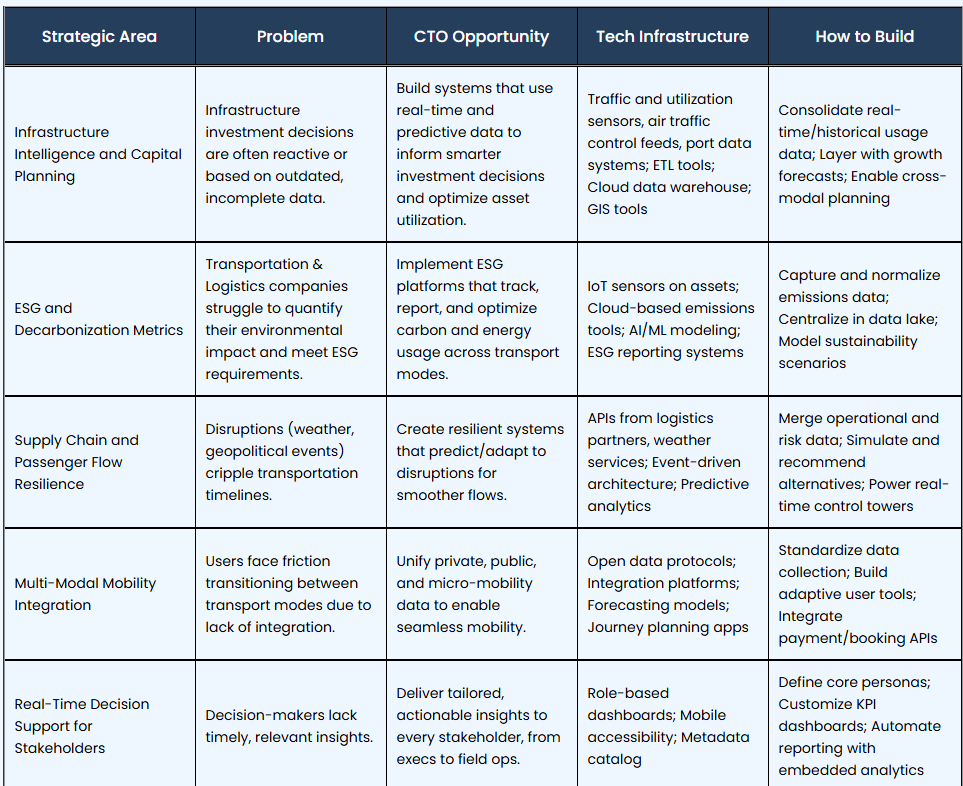
1. Infrastructure Intelligence and Capital Planning
Problem: Infrastructure investment decisions are often reactive or based on outdated, incomplete data.
CTO Opportunity: Build systems that use real-time and predictive data to inform smarter investment decisions and optimize asset utilization.
How to Build:
To achieve this, CTOs can build data infrastructure that brings together real-time and historical usage data from diverse transportation modes. This data can be layered with demographic trends and economic growth forecasts to support investment modeling. A centralized repository supports spatial analysis and long-term planning. Visualization and scenario tools should then be deployed to facilitate cross-modal capital prioritization and track ongoing performance.
2. ESG and Decarbonization Metrics
Problem: Transportation companies struggle to quantify their environmental impact and meet ESG requirements.
CTO Opportunity: Implement data-driven ESG platforms that track, report, and optimize carbon and energy usage across transport modes.
How to Build:
Build a data system that collects emissions and energy data from a variety of transportation modes. This data is then cleansed, standardized and assembled in a centralized platform, where powerful algorithms simulate alternative carbon-reduction strategies. Companies that combine operational and ESG datasets can monitor sustainability KPIs in real time, compare against targets, and dynamically change strategies.
3. End-to-End Supply Chain and Passenger Flow Resilience
Problem: Disruptions like extreme weather or geopolitical events often cripple transportation timelines.
CTO Opportunity: Create resilient systems that predict and adapt to disruptions in real time, ensuring smoother flow of goods and people.
How to Build:
Combine in-house operational data with external risk signals sourced from meteorological, geopolitical, and supplier systems. This necessitates an event-driven architecture that analyzes real-time updates and incorporates them into predictive models. Outputs are presented in operational control towers, allowing stakeholders to take prompt action. Furthermore, automated alarms and decision-support systems improve proactive risk management.
4. Multi-Modal Mobility Integration
Problem: Users often face friction when transitioning between different transport modes due to lack of integration.
CTO Opportunity: Develop platforms that unify private, public, and micro-mobility data to deliver seamless mobility experiences.
How to Build:
CTOs should develop an integration layer that standardizes mobility data across providers. This includes synchronizing schedules, occupancy, and availability. Once unified, this data can feed journey planning tools and support dynamic demand forecasting. A consumer-facing application can leverage real-time updates to optimize travel routes and costs, while backend systems manage pricing, booking, and service coordination.
5. Real-Time Decision Support for Stakeholders
Problem: Decision-makers across departments lack access to timely and relevant insights.
CTO Opportunity: Deliver tailored, actionable insights to every stakeholder, from executives to field operators.
How to Build:
The idea here is role-based data access and customized analytics interfaces. CTOs should define stakeholder personas and align data outputs to their specific KPIs. Dashboards and alerts can then be designed to surface timely, relevant insights. Embedding these tools into daily workflows, whether through mobile apps, portals, or integrations, ensures that every role has decision support where and when it’s needed.
Overview of Technical Architecture
Here’s an overview of the technical architecture required for Transportation Analytics, covering data collection, integration, processing, analysis, and visualization, while ensuring scalability, interoperability, and real-time responsiveness:
1. Data Ingestion Layer
Purpose: Collect raw data from diverse and distributed sources.
Key Components:
- Sensor Streams: GPS, vehicle telematics, RFID, traffic signals, aviation systems (e.g., ADS-B), maritime tracking, rail sensors
- External Feeds: Weather APIs, geopolitical alerts, fuel pricing data, public transportation schedules (GTFS, GBFS)
- Enterprise Systems: ERP, TMS, SCM, ticketing systems, IoT platforms, mobile apps
- Batch Uploads: CSV/XML/JSON files from partners and agencies
2. Data Integration and Processing Layer
Purpose: Clean, transform, and standardize data for unified analysis.
Key Components:
- ETL/ELT Pipelines: To extract and transform data from disparate systems
- Data Normalization: Harmonize timestamps, units, taxonomies across transport modes
- Metadata Management: For lineage, quality, and governance
3. Centralized Data Storage
Purpose: Persistent and queryable storage of historical and real-time data.
Key Components:
- Cloud Data Warehouse or Lakehouse: For storing high-volume, multi-source data
- Cold & Hot Storage Tiers: Based on access frequency and performance needs
- Spatial & Temporal Indexing: For geospatial and time-series analytics
4. Analytics & Modeling Layer
Purpose: Generate insights through BI, predictive, and prescriptive analytics.
Key Components:
- Descriptive Dashboards: Role-based KPIs (utilization, delay, emissions, throughput)
- Predictive Models: Demand forecasting, disruption prediction, maintenance analytics
- Spatial & Temporal Indexing: For geospatial and time-series analytics
5. Real-Time Decision Layer
Purpose: Power live decision-making for control towers and dynamic systems.
Key Components:
- Event Stream Processing: Detect incidents, delays, or bottlenecks
- Alert & Notification Systems: Automated response recommendations
- Control Tower Interfaces: Unified view for operations teams
6. Visualization & User Access Layer
Purpose: Deliver actionable insights to business users and operational staff.
Key Components:
- Interactive Dashboards: Customized for executives, planners, operators
- Self-Service BI Interfaces: Ad hoc analysis and exploration
- Mobile & Field Apps: Data access for on-the-go teams (drivers, field inspectors)
7. Security, Compliance, and Governance Layer
Purpose: Ensure data privacy, compliance, and reliable governance.
Key Components:
- Access Controls: Role- and policy-based permissions
- Audit Trails & Logs: For compliance and incident tracking
- Data Catalog & Lineage Tools: For discoverability and quality assurance
Transportation is no longer just about logistics, it’s about intelligence. CTOs have the opportunity to lead their organizations toward a smarter, more responsive, and sustainable future by rethinking analytics beyond fleet operations.
Data-Driven Organizations Are 3x More Likely to Achieve Better Business Outcomes
DiLytics helps organizations modernize analytics, improve decision-making, and turn complex data into a competitive advantage.
How DiLytics Can Help
DiLytics specializes in building advanced, end-to-end analytics solutions tailored for the complex needs of the transportation sector. From integrating siloed data to developing predictive models and Agentic AIs, DiLytics helps organizations unlock actionable insights at scale. With deep expertise in data engineering, visualization, and governance, DiLytics empowers CTOs to transform transportation analytics into a strategic advantage.