
Data silos to Data Warehouses – Harness the power of your enterprise data
“Data is the new oil” is the quote that we keep reading very often nowadays. What if the data is spread across multiple systems and formats in an organization? Similar to oil, extraction is easy if all of the data is available in one place.

However, the other argument is data cannot be compared to oil based on true scarcity. Data has no use if it is not connected and doesn’t provide insights to make decisions or identify patterns.
As enterprises have been focusing on the utilization of data, there is a struggle to find the best path to consolidate and enhance access. All enterprises with operations in multiple countries are living with this challenge while most of them are making efforts for consolidation in a small or a big way. For most marketing departments, data silos become a hindrance to implementing hyper-personalization which is critical to draw in and retaining customers.
Reasons for Data silos
Growth
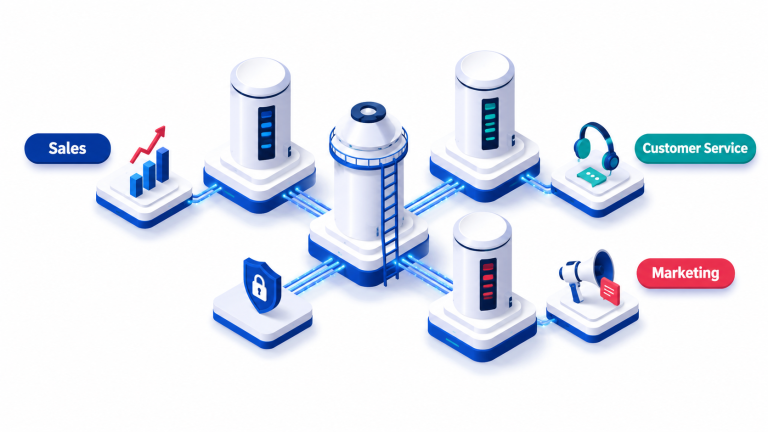
Data silos predominantly happen at the time of expansion. During the fast-paced growth periods, planning and long-term view of processes and systems take a back seat. The efficiency of each department becomes the key focus and that leads to the building/deployment of multiple systems. In most cases, there will be no governing body that has a holistic overview.
Technology
Much before the rise of ERPs, CRM, and Cloud adoption, enterprises have built disparate applications and data systems internally. All the out-of-the-box solutions didn’t fit the specific needs. IT leaders at different locations adopted different tools to build what they need based on the available knowledge and talent without a uniform technology stack. This resulted in multiple applications with different architecture, processes, and outputs. Consolidation largely happened at HQ using excel sheets or delimited formats.
Operations & Hierarchy
Operational models, structure, and hierarchy contribute a great deal in terms of creating data silos. Hierarchy limits access to everyone and results in multiple copies of data, enterprises with a large network of suppliers, distributors, and dealers will have multiple formats of similar data coming to them. The accuracy of data becomes a challenge for consolidation. In some organizations, Sales teams will not be ready to share information with others. Most of the old systems are not provisioned to share information easily with others. Governance and security have no standardization and become a prerogative of the concerned department.
Implications of data silos
The different ways data silos are silently killing your business are:
Limitations in the view of data
Silos restrict sharing of the vital information. The scope of each department’s investigation is constrained by the viewpoints of those inside it. Without an enterprise-wide perspective of data, finding inefficiencies throughout the whole organization is impossible.
Data Integrity compromised
Too many data silos will lead to access to multiple people which makes it tough to monitor the misuse of data. There are high possibilities of the same information getting stored in various databases which in turn leads to redundancy and inconsistencies. As the data ages, the relevance goes down. For instance, if medical data of a patient is maintained in multiple systems, there are more chances of errors while entering the data and at some point, it would fall out of sync with each another.
Wastage of Resources
When the same information is entered and stored in multiple systems, it reflects the wastage of time and effort in terms of manpower and resources in terms of storage and maintenance.
Disturbs the collaborative work culture
Silos are produced by culture, which then reinforces it. Collaboration is being embraced by data-driven firms as a potent tool for uncovering and utilizing fresh ideas. Departments require a mechanism to communicate their data to promote teamwork. Collaboration fails when it is difficult or impossible to communicate data.
Challenges in breaking data silos
Few enterprises realize the challenge of data silos early and try to consolidate. In the majority of cases, while the problem is acknowledged, undoing them can be complicated and hence delayed and the complexity keeps increasing. Apart from technology changes, the adoption of new systems by employees also poses hurdles in this process. Hierarchies and permissions add more layers to the process of reconciliation.
The solution from data silos
Moving data into a data warehouse simplifies this process as the warehouse will act as a central repository. Managing access will be easy for a data warehouse and they help to build analytics on top of it. Companies might use either scripting or ETL (Extract, Transform, Load) or ELT (Extract, Load and Transform) tools in the process of building data lakes or data warehouses.
ETL enables an effective approach to gathering, process, and enhancing crucial business data for better company performance and decision-making by facilitating communication between the source and destination systems. ETL comprises exploratory data analysis, data visualization, data science, machine learning, and any necessary data transformations or cleaning to support business operations. ETL is a great choice if you need transformations with business logic and granular compliance on in-flight data.
ELT is a data integration process that transfers data from a source system into a target system without business logic-driven transformations on the data. ELT works better if you’re looking for low maintenance, rapid data loading with a high degree of automated workflows.
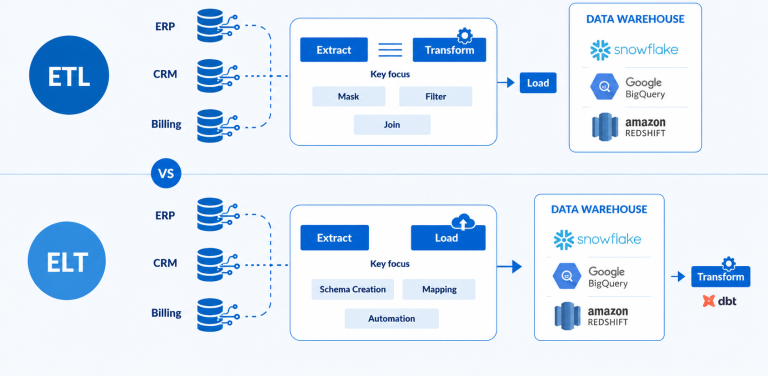
The increased adoption and affordability of cloud storage have made ELT more popular in recent times. As ETL pipelines are not able to handle the high volumes and the variety of data, there is no longer a need to reduce or filter data during the transformation stage. This lead to Enterprises storing all their unstructured data in the cloud and transforming it later as needed.
Conclusion
The most preferred way to solve the problem of data silos is to create data lakes or build data warehouses. In our experience, we have faced many clients who were using various technologies and data management systems for different departments and struggled to get them together.
Dilytics can help organizations in the initial discovery, solution assessment, and implementation of data warehouses or data lakes. We have experience working with multiple tools which can access hundreds of data sources, native data connectors, and hundreds of available drivers which can cover all your enterprise data sources.
To know more about how to streamline your data challenges, please click the below link or drop a note with your details at insights@dilytics.com.
Data-Driven Organizations Are 3x More Likely to Achieve Better Business Outcomes
DiLytics helps organizations modernize analytics, improve decision-making, and turn complex data into a competitive advantage.