
Grant Performance Analytics for Public Agencies: Closing the Loop Between Data, Outcomes, and Accountability
Why Grant Performance Analytics Has Become a Public Sector Imperative
Across federal, state, and local agencies, grant funding plays a critical role in driving public impact. From housing support programs to transportation modernization, clean energy adoption to public health interventions, and education improvement to community development, grant funding is often the lifeline that enables public organizations to act on their mandates. In the United States alone, more than half a trillion dollars in federal grants are distributed annually across hundreds of thousands of awards to state and local governments, tribes, nonprofit organizations, and institutions, accounting for roughly 4–5% of U.S. GDP and constituting one of the largest mechanisms for intergovernmental aid and public program delivery.
Yet, despite the vast scale of investment, a significant portion of federal grant programs lack robust measures of performance: evaluations by the Office of Management and Budget have found that nearly half of assessed grant programs do not demonstrate measurable results, highlighting a persistent gap in understanding not just where the money went, but what difference it made.
Several converging forces are fuelling this challenge and reshaping the way public agencies approach grants management. These are:
- Rising demand for transparency: Public agencies are under increasing pressure to demonstrate that grant dollars are being used effectively, equitably, and in alignment with intended outcomes. A traditional focus on financial compliance alone is no longer sufficient; stakeholders now expect proof of impact – clear, data-backed evidence showing how funds have translated into measurable social, economic, or environmental results.
- Complex program delivery models: Many grant programs operate across multiple departments, partner organizations, and community intermediaries. As funds move through this layered ecosystem, tracking execution and ensuring accountability becomes increasingly difficult. Each stakeholder may maintain its own data systems and performance metrics, creating silos that limit end-to-end visibility into overall program effectiveness.
- Rapid growth and fragmentation of data: Public agencies today generate and receive vast volumes of information – from financial transactions and project milestones to demographic, operational, and geospatial data. However, much of this information remains scattered across disconnected systems that don’t “talk” to each other. The result is a fragmented data landscape that makes it challenging to assemble a holistic view of program performance or identify where interventions are needed most.
- Policy and equity requirements: Increasingly, agencies must not only deliver outcomes but also demonstrate that those outcomes are equitable, ensuring resources reach underserved communities and access barriers are addressed. This requires a more nuanced and data-driven approach, where agencies can measure who benefits from grant-funded activities, not just what is being delivered.
Modernizing Grant Insights: Moving from Compliance Checks to Impact Measurement
For decades, grant reporting has been oriented primarily around compliance. Agencies were asked to demonstrate that funds were spent and allocated properly, recipients were eligible, procurement guidelines were followed, and documentation was retained. While compliance is essential, it does not fully answer the questions that public agencies are increasingly being asked today:
- Did the program achieve the intended outcomes?
- Was the funding directed to the areas of greatest need?
- Did it create sustainable improvement, or only temporary relief?
- Were resources used efficiently and equitably?
These questions require insight into performance, not just spending. This shift cannot be achieved through traditional and static spreadsheets and manual narrative reports. It requires data integration, analytics maturity, and decision intelligence. This is where Grant Performance Analytics enters the picture.
What is Grant Performance Analytics and What it Enables
Grant performance analytics refers to the systematic use of data to measure how effectively a grant is being managed, how funds are being used, and what outcomes or results the grant is delivering. It is a disciplined application of integrated data, advanced analytics, and performance measurement to understand how well a grant is functioning – financially, operationally, and in terms of measurable real-world impact. It provides answers to questions such as:
- Are funds being utilized on schedule, and are we pacing correctly against the grant timeline?
- Which programs, providers, or geographies are delivering strong results – and which ones require intervention?
- Where is beneficiary reach or impact lower than expected, and what factors may be contributing to it?
- What early-warning signals indicate future risks such as underspending, delays, non-compliance, or equity gaps?
- How should strategy, resource allocation, or next-year funding decisions be adjusted based on evidence?
These insights elevate the role of data from record-keeping to actionable decision-making. This doesn’t just improve day-to-day program delivery but also supports better policy decisions, faster adjustments, and stronger outcomes for communities. With a clear view of spending, performance, and results, agencies can strengthen program integrity, improve beneficiary outcomes, optimize resources use, and build confidence with oversight bodies and the public. Most importantly, this allows agencies to tell the full story – not just how funds were spent, but how those funds made a tangible difference in people’s lives.
Key Components of Grant Performance Analytics
Delivering performance-driven grant management requires more than simply tracking reports or expenditures. Agencies need a consistent and structured way to connect funding decisions with real outcomes – to see not just how money was spent, but what actually changed because of it. This means moving past siloed systems, scattered metrics, and after-the-fact reporting. Instead, agencies need a strong analytics foundation that brings together the right data, clear performance indicators, and timely insights for everyone involved in managing a grant. This creates a complete, real-time view of performance and helps agencies make better, faster, and more accountable and transparent decisions.
To make this possible, a modern Grant Performance Analytics framework must be built on five essential capabilities:
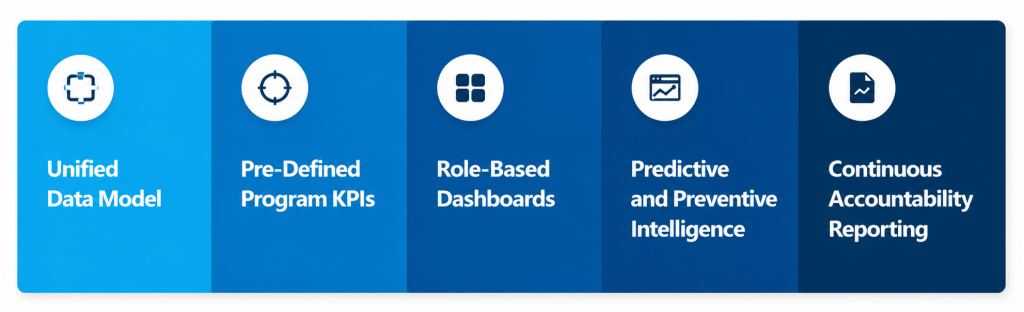
- Unified Data Model: In most public agencies, financial data lives in one system, program delivery data in another, demographic or beneficiary information resides somewhere else, and outcome or impact data may exist only in spreadsheets or narrative reports. When each team sees only its own slice, no one gets the full picture of how funds translate into results. A unified model addresses this challenge by linking financial, operational, demographic, service, and outcome data into a single, connected framework. With this foundation, an agency can trace a clear and continuous line from dollars allocated → dollars spent → activities delivered → people served → outcomes achieved.
- Pre-Defined Program KPIs: A performance-driven grant environment needs KPIs that look beyond activity counts and focus on capturing the actual change those activities create. Many agencies stop at output metrics like “number of workshops held” or “number of households served,” which describe effort but not impact. True performance analytics requires outcome KPIs such as “percentage of participants who secured stable employment,” “reduction in wait times for critical services,” or “increase in households achieving long-term stability.” By defining these KPIs early and consistently, agencies ensure everyone – from program staff to leadership – is aligned on what success really looks like.
- Role-Based Dashboards: A single grant program is viewed through very different lenses depending on who’s looking at it. A CFO cares about financial health and risk, so they need real-time visibility into burn rate, utilization pacing, budget vs. actuals, etc. Program directors, on the other hand, focus on delivery, so they need visibility into services rolled out on time, targets being met, partners and subrecipients performing as expected, etc. Field teams need day-to-day execution insights such as workload distribution, pending tasks, caseloads, service backlogs, etc. Finally, executive leadership requires a high-level, strategic view: outcomes achieved, progress toward equity goals and the translation of investments into measurable public value, etc. By tailoring dashboards to these unique lenses, agencies ensure that each stakeholder sees exactly what they need.
- Predictive and Preventive Intelligence: Predictive and preventive intelligence is where grant performance analytics becomes especially transformative. Instead of waiting for quarterly reports to reveal problems, AI can continuously monitor incoming financial, operational, and program data to spot early warnings. For example, AI models can flag grants that are underspending against plan, giving leaders time to proactively reallocate resources or accelerate procurement before funds lapse. It can detect service delivery slowdowns when field activity begins to fall behind schedule, enabling managers to intervene before performance targets are missed. AI can also identify beneficiary drop-off patterns – such as lower participation in specific regions, age groups, or service tracks – so agencies can adjust outreach strategies in near real time. And when vendor or partner performance begins slipping, predictive indicators highlight issues before they escalate into compliance findings.
- Continuous Accountability Reporting: Performance analytics are most valuable when they are woven into regular decision cycles. Insights from dashboards and AI models should feed directly into quarterly performance reviews to guide immediate corrective actions. They support legislative reporting by providing accurate, up-to-date results tied to funding and impact. They help refine strategy by showing what’s working and what needs adjustment. And they play a critical role in next-year budgeting and program design, ensuring that funds are allocated based on evidence rather than assumptions. Continuous feedback makes performance management a living process, not a year-end exercise.
Together, these capabilities shift oversight from reactive (discovering issues after the fact) to proactive (preventing issues before they harm outcomes). Instead of learning about problems too late, agencies gain a forward-looking radar that helps them keep programs on track, improve service delivery, and protect public dollars.
Grant Performance Analytics: Custom Solution or Ready-to-Use Platform?
Public agencies increasingly recognize the need for strong, data-driven grant performance management – but the path to achieving this is often not straightforward. For years, many organizations have pursued custom-built analytics systems, crafted from the ground up to match unique program structures, funding models, and reporting demands. While these solutions can be highly tailored, they also require significant investment. Long implementation cycles, complex data integration work, iterative KPI development, and ongoing support from specialized analytics staff make custom builds difficult to sustain, especially for agencies already challenged by limited staff capacity, tight budgets, and urgent compliance deadlines. In many cases, by the time a custom solution is fully deployed, needs, policies, or funding requirements may have already shifted.
These realities are pushing agencies toward a more pragmatic, faster, and cost-effective model: ready-to-use, configurable analytics platforms specifically built for grants. These platforms offer a strong foundation from day one – including pre-defined data models aligned to federal and state grant structures, standardized KPIs reflecting widely adopted performance frameworks, and role-based dashboards for finance, program delivery, field operations, and executive oversight. Because the core components are already built, agencies can quickly connect their data and begin generating insights immediately, without the long ramp-up associated with custom solutions.
Modern platforms also embed features such as automated data quality checks, built-in compliance indicators, and increasingly, GenAI-powered insights that generate narrative explanations, performance summaries, and actionable trend interpretations. The result is faster time-to-value, lower implementation risk, and the ability for agencies to focus less on building the analytics infrastructure and more on using insights to improve grant performance and deliver meaningful community outcomes.
Turning Insight into Impact: DiLytics Ready-Made GenAI Powered Grant Insight Solution
DiLytics Grant Insight Solution is a ready-to-use, GenAI-powered grant performance analytics platform that unifies financial, operational, and program data to give agencies a complete, real-time view of how their grants are performing. Instead of piecing together spreadsheets or navigating multiple systems, agencies get a connected, drillable, and analytics-ready environment that answers the key question: Are our grant dollars delivering the outcomes we promised?
A high-level architecture of DiLytics Grant Insight Solution is provided below:
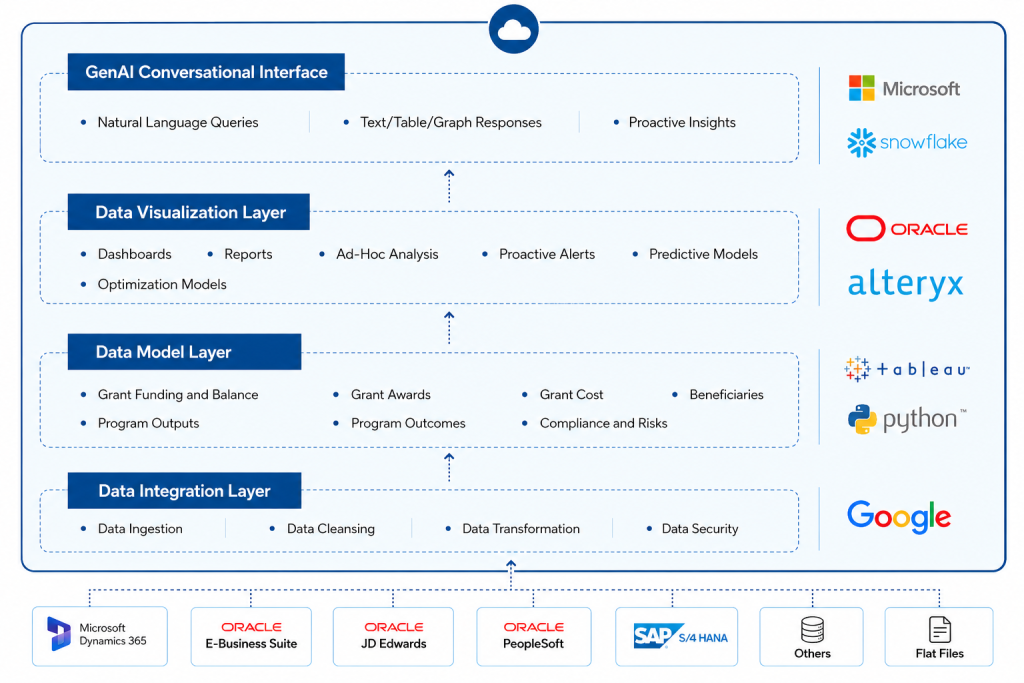
The solution provides full transparency into both grant financial management and grant performance, enabling agencies to track how funds are approved, committed, spent, and translated into measurable results. It offers clear visibility into Awards Approved, Pending, and Posted Amounts across Budgets, Encumbrances, and Actuals, while also linking financial discipline to program execution, outputs, and outcomes. Users can analyze raw and burdened costs at the account, project, and task levels to understand not only where funds are flowing, but also how effectively they are being used to achieve program objectives.
Each subject area in the solution is designed to answer a different part of the performance story:
- Grant Funding and Balance: Focuses on fund availability and financial planning: balances, installments, budget versions
- Grant Awards: Focuses on the grant itself: approvals, allocations, and commitments
- Grant Cost: Focuses on spending and financial analysis: actuals, burdened costs, allocations
- Beneficiaries: Focuses on the people and communities reached by the grant
- Program Outputs: Focuses on the direct deliverables produced by grant-funded activities
- Program Outcomes: Focuses on the results and effectiveness of grant programs
- Compliance and Risks: Focuses on adherence to grant requirements and identification of potential issues

These subject areas provide agencies with robust visibility into both financial and operational performance, enabling informed decision-making and effective performance management:
With GenAI embedded throughout, DiLytics’ Grant Insight Solution automatically produces narrative insights, risk flags, KPI summaries, and plain-language explanations that help leadership, program directors, and field teams understand what’s happening and why.
With DiLytics’ GenAI-powered Grant Insight Solution, agencies gain more than dashboards – they gain the ability to connect dollars to outcomes, communicate impact with clarity, and move from reactive reporting to proactive performance management. The result is a grant environment where:
- Accountability is built-in,
- Transparency comes naturally,
- Decisions are evidence-driven, and
- Every dollar can be tied to meaningful public impact
For a real-life case study about how DiLytics’ Grants Insight solution enabled Los Angeles County Sanitation Districts enhance both efficiency and community impact of their grant funded programs, read here.
Data-Driven Organizations Are 3x More Likely to Achieve Better Business Outcomes
DiLytics helps organizations modernize analytics, improve decision-making, and turn complex data into a competitive advantage.
Conclusion
Public trust grows when agencies can clearly and confidently explain how grant money was used, who benefited, what impact was created, and what should happen next. Grant Performance Analytics helps make this possible. It doesn’t just improve day-to-day program delivery; it also supports better policy decisions, faster adjustments, and stronger outcomes for communities. With a clear view of spending, performance, and results, agencies can strengthen program integrity, improve beneficiary outcomes, optimize resources use, and build confidence with oversight bodies and the public. Most importantly, it allows agencies to tell the complete story – not just how funds were spent, but how those funds made a real difference in people’s lives.