
Get More from Your Data: How Analytics Audits Drive Business Benefits
Are inefficiencies in your processes clouding your analytics systems’ ability to deliver actionable insights?
Do data inconsistencies compromise trust and accuracy in critical decision-making?
These challenges often remain unnoticed until they escalate into significant obstacles, affecting both performance and outcomes. Don’t wait for these issues to derail your operations or for missed opportunities to impact your growth. Take control now by scheduling an analytics health check and set your business on the path to smarter, data-driven success!
Data analytics systems are the backbone of modern business intelligence (BI), enabling organizations to transform raw data into meaningful insights that drive strategic decision-making and foster competitive advantages. However, even the most sophisticated analytics platforms are not immune to challenges. Performance bottlenecks, data inaccuracies, and misalignment with evolving business goals can significantly diminish their effectiveness over time.
These issues often arise from a combination of factors, including:
- Data Quality Issues: Incomplete, inconsistent, or outdated data can lead to inaccurate reporting and misinformed decisions
- Lack of Regular System Updates: Failing to update analytics platforms results in inefficiencies, security vulnerabilities, and reduced system performance
- Complex Data Integration: Managing multiple data sources with different formats can introduce inconsistencies and reporting delays
- Evolving Business Requirements: Rapid business changes demand flexible analytics systems that can adapt to new KPIs, compliance regulations, and operational models
- Scalability Challenges: As businesses grow, their analytics systems must be able to handle increasing data volumes and user loads efficiently
Left unchecked, these problems can lead to missed opportunities, higher costs, and reduced user adoption. This is where a comprehensive analytics health check proves invaluable.
A data analytics health check is a structured, end-to-end evaluation of your analytics ecosystem, focusing on enhancing reporting dashboard usability, optimizing the ETL (Extract, Transform, Load) process, and facilitating cross-team collaboration. It identifies gaps, inefficiencies, and areas for improvement to ensure that your analytics system delivers accurate, timely, and actionable insights. By streamlining data integration, improving visualization effectiveness, and ensuring seamless data sharing across departments, a health check helps organizations maximize the value of their analytics investments and drive informed decision-making.
Regular health checks are not merely a diagnostic tool but a strategic investment in the sustained effectiveness of your analytics framework.
In this blog, we’ll address the 4 Ws of an Analytics Health Check—Who needs it, What it entails, When to perform it, and most importantly, Why it’s critical for your business success.
By the end, you’ll understand how a health check can future proof your analytics systems and enable smarter decision-making across your organization.
Who Needs an Analytics Health Check?
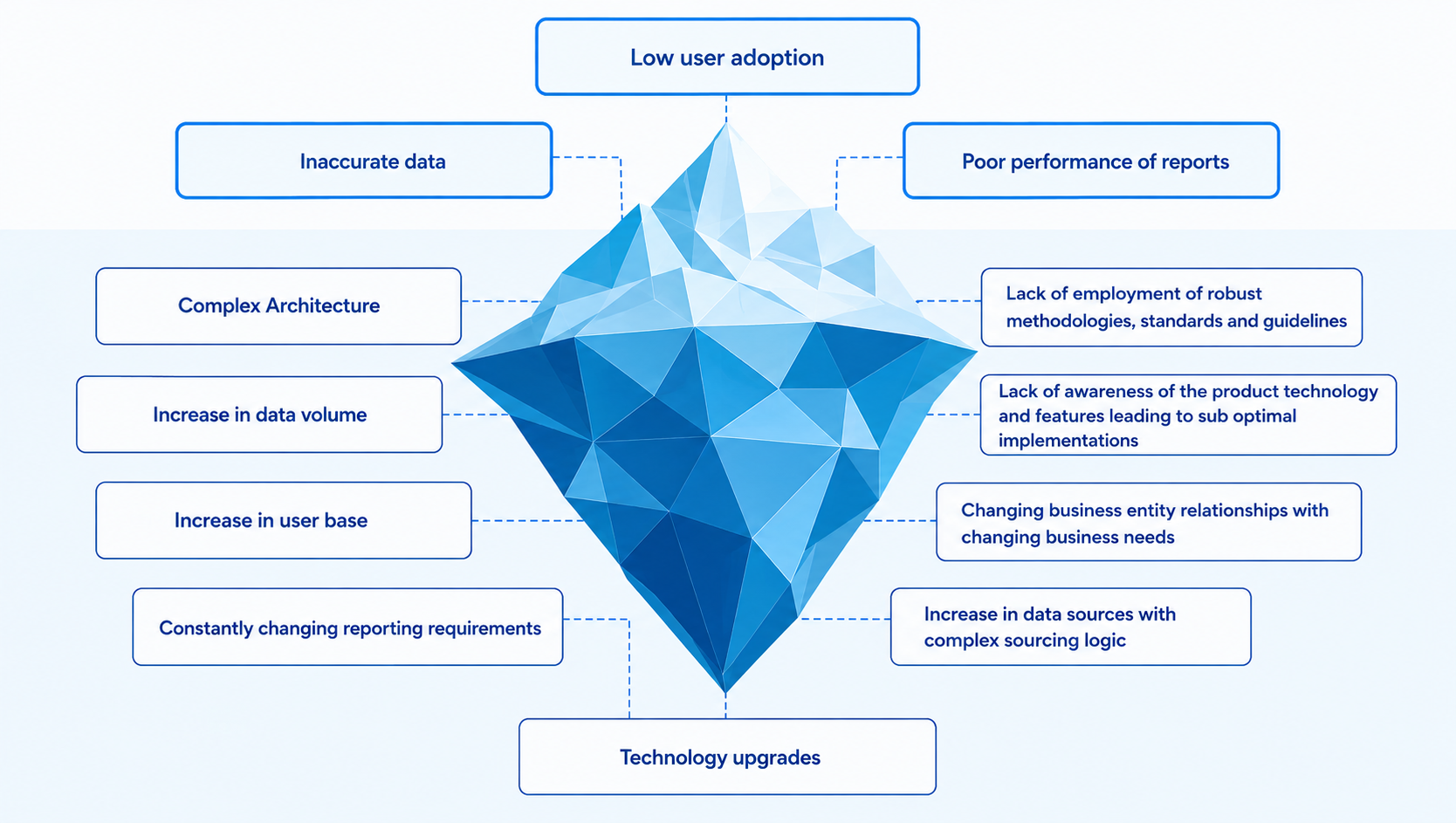
Analytics systems are critical to modern business success, yet many organizations face hurdles that reduce their effectiveness. Low user adoption, inaccurate data, and poor report performance are often symptoms of deeper issues within the analytics ecosystem. Below are some common challenges organizations face:
- Complex Architecture: Overly intricate data systems, such as multiple disconnected data warehouses, redundant ETL pipelines, and excessive layers of data transformation, can lead to delayed insights and decreased trust in analytics outputs
- Increase in Data Volume: Without proper scaling mechanisms, higher data volumes can overwhelm systems, leading to slow report generation and data inaccuracies
- Increase in User Base: A growing user base can strain an analytics platform, resulting in slower query responses and poor user experience
Constantly Changing Reporting Requirements: New KPIs, regulatory compliance changes, or business model shifts (e.g., moving to a subscription-based revenue model) can cause misalignment between business needs and system capabilities - Technology Upgrades: New analytics technologies may introduce compatibility issues if not properly integrated
- Lack of Robust Methodologies, Standards, and Guidelines: Inconsistent methodologies lead to fragmented implementations and unreliable analytics outputs
- Limited Awareness of Product Technology and Features: Many users underutilize analytics platforms due to a lack of awareness of available features
- Changing Business Entity Relationships: Evolving internal structures and hierarchies can impact analytics accuracy if not properly updated
- Increase in Data Sources with Complex Sourcing Logic: Integrating new data sources can introduce inconsistencies and reporting challenges
An analytics health check is more than a diagnostic tool. It is a proactive measure to future-proof your data systems. It identifies hidden inefficiencies, ensures alignment with business goals, and equips your organization to address challenges head-on. By investing in regular health checks, businesses can boost user adoption, enhance data accuracy, and improve report performance, driving meaningful value from their analytics investments.
Don’t let these challenges slow you down. Conduct an analytics health check today and empower your organization to thrive in a data-driven world.
What are the Main Components of Analytics Health Check?
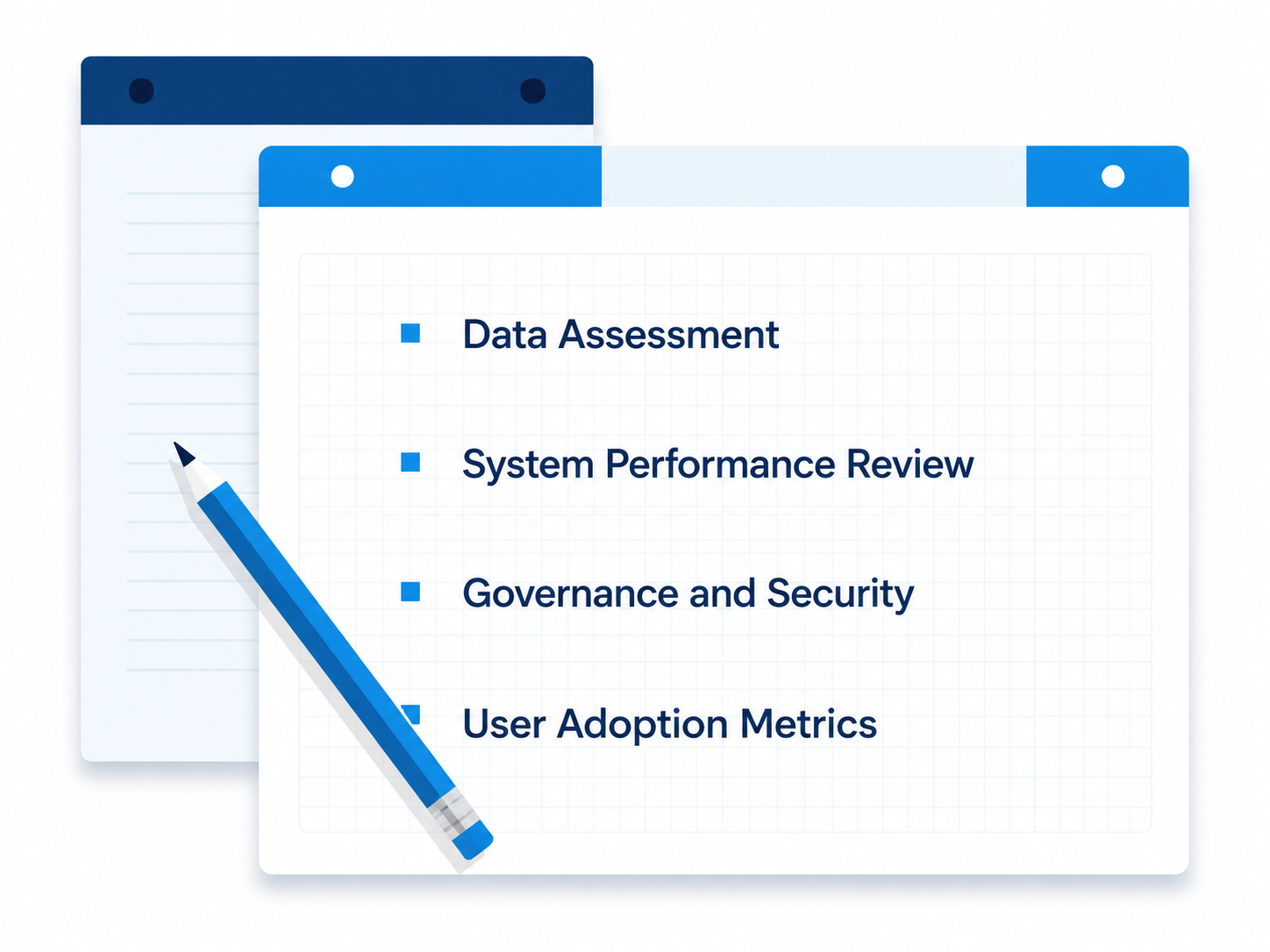
An analytics health check is a systematic evaluation that includes:
- Data Assessment: This step examines the quality and consistency of data, ensuring it aligns with the organization’s reporting needs. It includes evaluating the completeness, accuracy, and timeliness of data sources
- System Performance Review: The efficiency and reliability of analytics tools are tested to uncover latency, or scalability-related challenges. It involves benchmarking the speed of data processing and delivery against expected outcomes
- Governance and Security: The focus is on ensuring compliance with regulatory standards and protecting sensitive data. It involves assessing data management policies, user access controls, and auditing mechanisms to maintain integrity and security
- User Adoption Metrics: This measures how effectively users engage with the analytics platform. It includes surveys or analytics tracking to gauge satisfaction, identify training gaps, and understand usability challenges
When to do Analytics Health Check?

Companies may perform health check of their analytics implementations:
Proactive Health Checks
Forward-thinking companies prioritize the health of their analytics systems by performing proactive checks. These are conducted during critical milestones, such as system upgrades, platform rollouts, or feature enhancements, to ensure seamless functionality and robust performance.
Proactive checks help organizations preempt potential issues, validate that new implementations meet business requirements, and confirm system stability under evolving workloads.
This approach not only ensures that systems are running smoothly but also builds trust among end users by delivering consistently reliable insights. Proactive health checks are an investment in maintaining a future-ready analytics ecosystem that adapts seamlessly to business and technological advancements.
Reactive Health Checks
On the other hand, some organizations initiate health checks reactively, typically in response to challenges in their existing analytics systems. These challenges may include data inaccuracies, poor performance, or low user adoption, leading to dissatisfaction among end users and a lack of trust in the system.
Reactive health checks help identify and address the root causes of these issues, providing a clear roadmap for improvement. By addressing these problems, companies can rebuild user confidence and restore the system’s ability to deliver value.
Whether proactive or reactive, an analytics health check is a vital tool for maintaining a system that aligns with business goals and delivers high-quality insights. However, adopting a proactive approach is always preferable—it minimizes risks, optimizes performance, and ensures that your analytics system evolves in tandem with your business needs.
By performing regular health checks, organizations can reduce downtime, prevent disruptions, and maximize the ROI of their analytics investments. Don’t wait for issues to escalate—make analytics health checks an integral part of your data strategy today!
Why is Analytics Health Check Important?
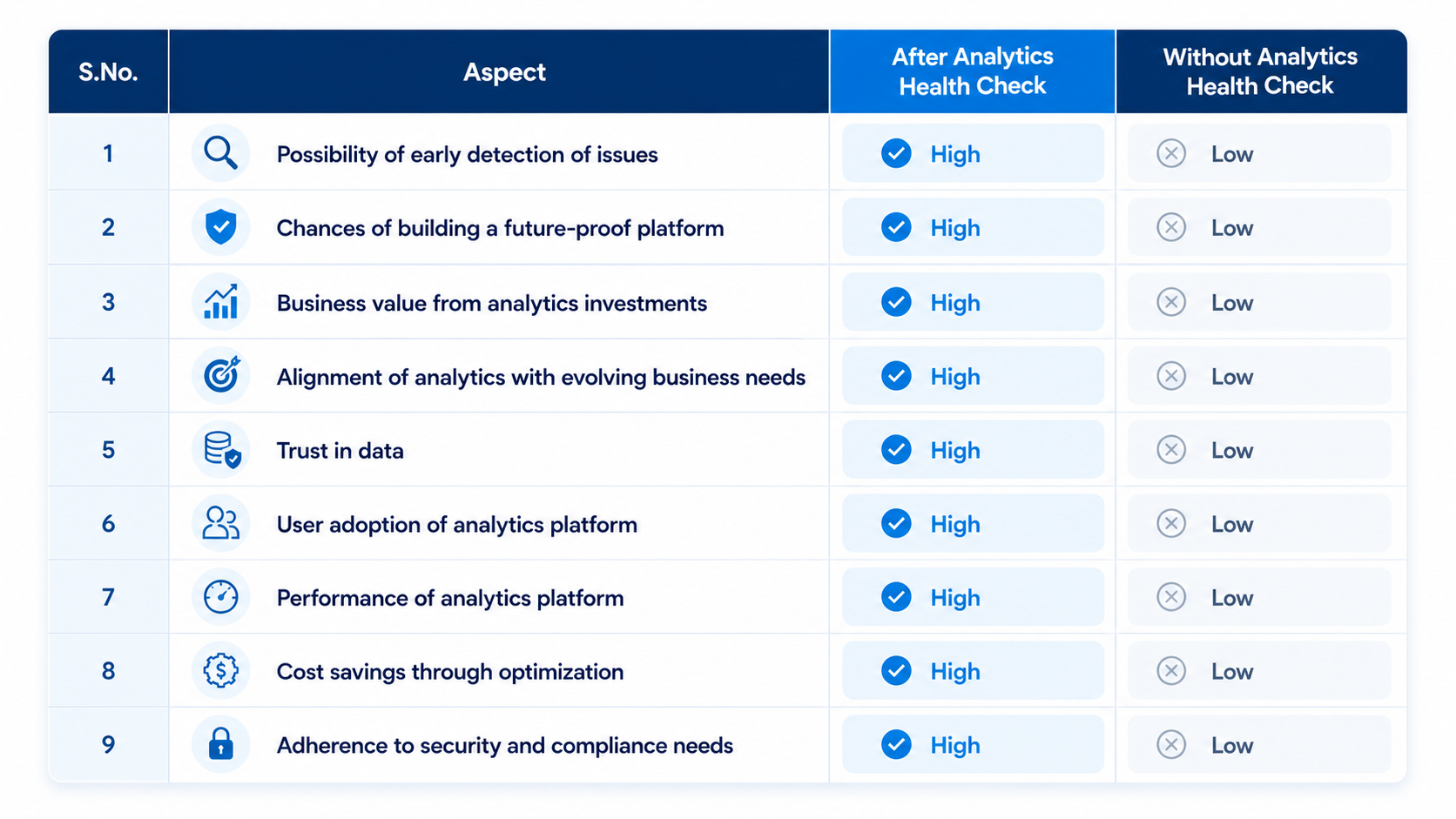
Analytics Health Check gives a clear indication of risk factors and performance inhibitors in the current analytics system. An existing system might be having underlying issues that if addressed will enhance its output multiple times. A timely health check will help in identifying those issues.
The best part about an analytics health check is it can provide benefits even if an organization is satisfied with their current analytics system. So, this is an opportunity to gain assured benefits within a short period of time. The two scenarios of benefits being achieved by companies satisfied or unsatisfied with their current analytics systems is described further.
If the thought of generating more cost savings, early detection of issues or alignment of analytics outcomes with evolving business needs has already crossed your mind, it is absolutely the time for you to perform an analytics health check. The health check offers a pathway to future-proof your analytics capabilities. By understanding current gaps, you can design a system that adapts to evolving business needs, integrates seamlessly with emerging technologies, and delivers long-term value. Cost savings through optimization is another key benefit achieved by addressing inefficiencies resulting in reduced operational expenses. Moreover, aligning analytics capabilities with strategic business goals ensures that an organization remains competitive and agile in a rapidly changing environment.
Even when the analytics system is functioning well, regular health checks help ensure that an organization continues to extract maximum value from its analytics investments. These checks validate the accuracy and trustworthiness of your data, ensuring decisions are based on reliable insights. Additionally, assessing user adoption rates and platform performance can reveal opportunities to enhance user experience and system efficiency. Even small optimizations in speed, scalability, or data presentation can have a significant impact on operational outcomes. Ultimately, a proactive approach helps you stay ahead by keeping your analytics aligned with business goals and technology advancements.
Regardless of where your organization stands, an analytics health check provides a clear roadmap to elevate your data strategy. It identifies opportunities for optimization, ensures alignment with business objectives, and fortifies your system against future challenges. Investing in the health of your analytics platform is an investment in your organization’s ability to make informed, impactful decisions.
How Dilytics Can Help your organization achieve your desired results
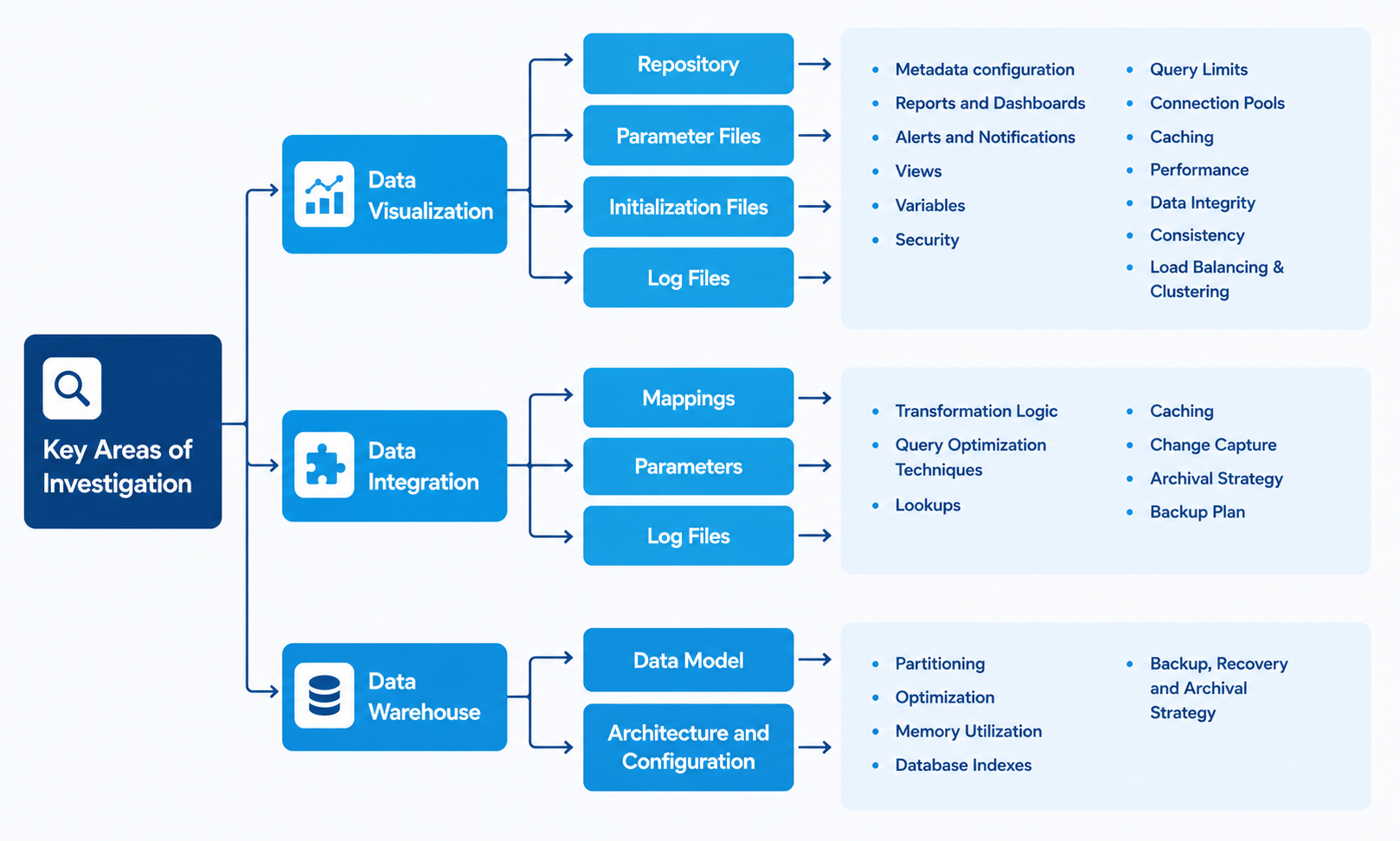
At Dilytics, we specialize in transforming analytics systems into high-performing assets that drive business value. DiLytics has defined a four-step methodology for performing a health checkup which is customizable according to the needs of the customer. The data analytics, data warehousing and data visualization needs are determined and listed down during the initial stages of the Health Check with the help of a thorough investigation.
Each of the Data Visualization, Data Integration and Data Reporting layers have unique areas of focus and process of investigation.
The investigation process for an analytics health check in the data visualization layer focuses on examining the critical components and sub components that ensure efficient, accurate, and secure reporting.
- Starting with the Repository, which stores metadata configurations, the process evaluates how well the metadata is organized and whether it supports seamless access to data
- Parameter and Initialization Files are reviewed to confirm proper configuration of variables, views, and connection parameters, ensuring consistency and alignment with reporting requirements
- Log Files are analyzed to identify performance bottlenecks, query execution issues, or system errors that could compromise data integrity or visualization accuracy
The investigation of the data integration layer during an analytics health check delves into ensuring that data flows seamlessly, transformations are accurate, and processes are optimized for performance and reliability.
- Mappings serve as the foundation, linking source and target systems, and are evaluated for consistency and correctness in handling transformation logic, including calculations, data cleansing, and format changes
- Parameters define dynamic elements such as runtime variables, and their configuration is assessed to ensure adaptability and proper handling of query optimization techniques for enhanced performance
- Log files are analyzed to identify bottlenecks, errors, or inefficiencies in integration workflows, enabling a deeper understanding of data pipeline health
The investigation process for the data warehouse layer during an analytics health check focuses on assessing the structural and operational integrity of the data warehouse to ensure it supports efficient, scalable, and reliable analytics.
- The data model is analyzed for its design, alignment with business needs, and normalization or denormalization strategies to optimize data retrieval and storage
- Subareas such as partitioning are reviewed to evaluate how well data is segmented for faster query execution and efficient management of large datasets
- The use of database indexes is examined to ensure they are appropriately implemented to improve query performance without overburdening system resources
The architecture and configuration are inspected to verify scalability, adherence to best practices, and efficient use of resources. Memory utilization is reviewed to ensure the system optimally manages in-memory operations for faster processing.
The overall investigation also considers compatibility with upstream data integration processes, downstream visualization tools, and alignment with governance policies. By correlating these areas and subareas, the health check ensures the data warehouse layer is robust, well-optimized, and capable of supporting the organization’s analytics demands effectively.
The typical time taken to perform an Analytics Health Check is 6 weeks. DiLytics has defined a four-step methodology for performing a health checkup. The stages and standard timeline for performing such an exercise is shown below:
To gain an understanding of how this works in real-time, take a look at the outcomes of Analytics Health Check performed by DiLytics for an American manufacturer and distributor of candy and chocolates (Link)
With Dilytics, your organization can unlock the full potential of its data and achieve measurable, sustainable growth. Let’s redefine your analytics journey!
Data-Driven Organizations Are 3x More Likely to Achieve Better Business Outcomes
DiLytics helps organizations modernize analytics, improve decision-making, and turn complex data into a competitive advantage.
Final Thoughts: Manufacturing Intelligence Is the Bridge to Better Clinical Outcomes
Clinical trials demand precision and consistency, even small changes in ingredients, processes, or equipment can lead to delays, higher costs, or risks to patient safety. This is where manufacturing analytics makes a big difference. By turning complex production data into clear insights, analytics helps pharma companies find issues early, prevent deviations, and stay aligned with regulations. Instead of reacting after problems occur, teams can predict, prevent, and optimize, moving medicines from lab to patient faster and more reliably.
With a pre-built solution like DiLytics Manufacturing Insight, this becomes even easier. Instead of spending months creating custom tools, pharma teams can instantly use ready-made dashboards built specifically for pharmaceutical manufacturing. These dashboards provide visibility into batch consistency, yield, cycle times, and quality metrics, all while following industry best practices and regulatory standards. The result? Streamlined operations, data-backed decisions, and a stronger compliance foundation.
Ready to explore how DiLytics can support your clinical and operational goals? Let’s connect for a quick conversation.