
Why Businesses Should Consider Snowflake for Their Data Warehousing Needs?
Businesses face many challenges while managing and analyzing their data. The challenges range from ensuring data quality, integration complexities, lack of real-time analytics, to scaling limitations. These challenges hinder them from extracting optimal value from their data.
Recently Snowflake has gained traction as a data warehouse solution that can help businesses address the above-mentioned challenges. The platform offers a range of features that help businesses build high-performance data solutions.
So, what makes Snowflake a preferred solution?
Let’s understand this and more in this blog. We’ll begin with the use cases and benefits of Snowflake. And, then move on to a real-life example on Snowflake implementation by leading US Public Sector Agency to help you get a practical view on how the platform helps businesses with their data challenges.
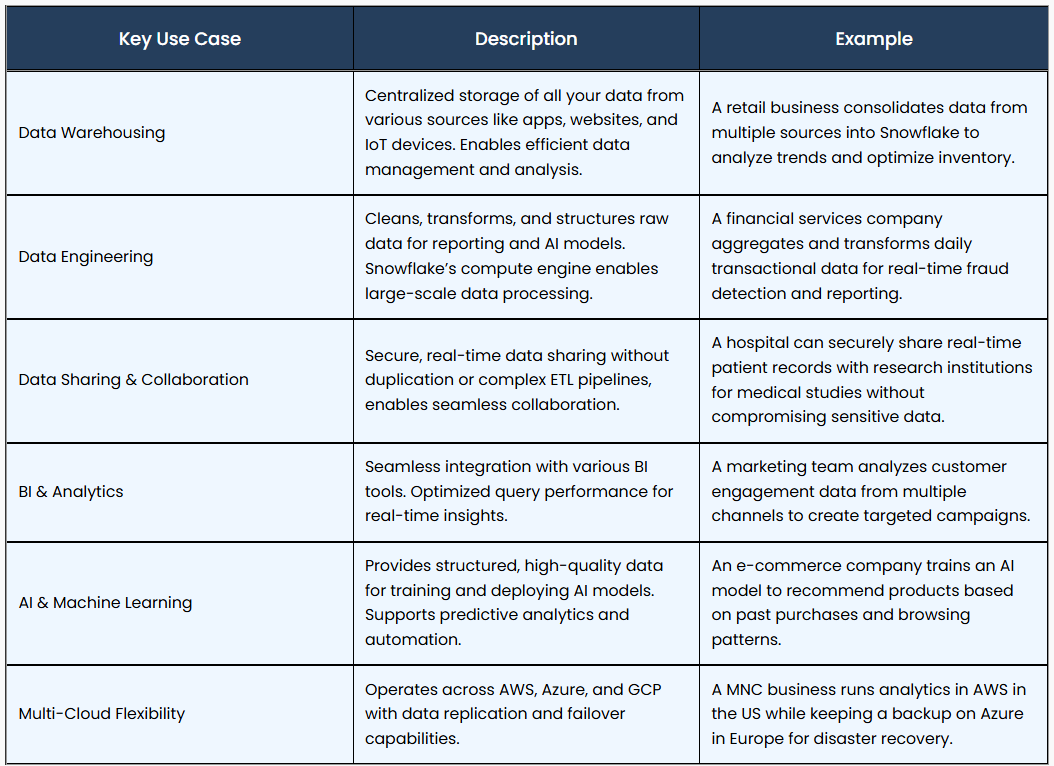
Key Benefits of Snowflake
Here are some key benefits of Snowflake that make it a powerful cloud data platform:
- Scalability: Snowflake ensures quick query speed without over-provisioning resources by automatically scaling up or down as per workload. By only paying for what they use, businesses reduce infrastructure expenses.
- Cost Efficiency: By separating computing and storage expenses, Snowflake reduces costs. It only charges for workloads that are active. By optimizing resources and eliminating excess capacity, businesses can lower their spending on Cloud infrastructure.
- High Performance: Snowflake offers multi-cluster design and intelligent query optimization. It enables fast execution of complex queries to facilitate real-time analytics.
- Fully Compliant: Snowflake enables compliance with regulations such as GDPR, HIPAA, and SOC 2. It also offers role-based access control (RBAC), multi-factor authentication (MFA), and end-to-end encryption for data security.
- Auto Maintenance: Snowflake automates maintenance, patching, and performance optimization, unlike traditional databases that need ongoing indexing, updates, and performance tuning. It frees IT staff to focus on other areas such as analytics and innovation.
- Secure Data Sharing: Businesses can share data in real-time without duplication using Snowflake. This eliminates redundant data and enhances teamwork.
Snowflake Success Story: How We Transformed the Data Process for a Leading US Public Sector Agency Using Snowflake
We collaborated with a leading US Public Sector Agency to enhance their workforce data management process.
Challenges Before Snowflake
- Workforce, payroll, and labor data were fragmented across various systems
- Compliance, payroll, and benefits reporting required significant manual effort
- There was a limited capacity for real-time trend analysis
- Non-technical users found it difficult to extract valuable insights
The Snowflake-Powered Solution
By utilizing Snowflake, we created a Unified Workforce Data Hub that:
- Consolidated multiple data sources into one platform
- Reduced manual labor by streamlining payroll and benefits reporting
- Improved decision-making with real-time insights into workforce trends
- Expanded adaptation by providing non-technical users hands-on training and user-friendly dashboards
Key Outcomes
- Reporting processes are now more precise and faster
- Workforce planning is assisted by data-driven insights
- Snowflake’s cutting-edge security features ensure regulatory adherence
- Employees can generate their own reports with the help of simple tools
Snowflake is bringing a massive transformation to data management. It provides the foundation for attaining true data efficiency for businesses.
If you’re looking to leverage Snowflake for your data process, then DiLytics can be your ideal partner. We have experience implementing Snowflake for businesses and helping them optimize their data capabilities. Get in touch with us for a quick chat here.
Data-Driven Organizations Are 3x More Likely to Achieve Better Business Outcomes
DiLytics helps organizations modernize analytics, improve decision-making, and turn complex data into a competitive advantage.